Published Umar Rana 11 min read
Systems & Process
How to Build in the AI Era: Learning, Foresight, Decisions and Actions
Delivered as a keynote at the International Conference on Advancements in Information Systems and Artificial Intelligence 2026, University of Management and Technology (UMT), Lahore.
Everyone can Google what ChatGPT does. Everyone can read about the latest AI breakthrough. That’s not the hard part anymore.
The hard part is this: how do you build something meaningful when build cycles that used to take 18 months now take 6? When validation windows that were 6 months are now 2 weeks? When market shifts that gave you 5 years now give you 18 months?
At the UMT AI conference this January, I was invited to talk about AI advancements. I didn’t want to. That information becomes outdated within weeks. Instead, I wanted to share something more durable: the practices that determine whether AI makes you faster or just makes you fail faster.
I’m publishing this because I keep hearing the same question in different forms: “How do we move faster without turning the whole business into a chaos machine?” The answer isn’t another tool. It’s a set of operating practices; more importantly, it’s the inputs you feed them.
If you only remember one thing: practices don’t save you. Inputs do.
The framework (4 practices):
- Constant learning
- Foresight (pattern recognition)
- Decision-making (identify the critical few)
- Action (build in blocks)
What follows is the framework I shared at that conference. Four practices I’ve applied over years, from building failed products, to scaling platform infrastructure serving hundreds of businesses.
This is a decision-making framework for product leaders and founders building in the AI era, when feedback loops are weeks, not quarters.
The Landscape That Changed
We’re living through unprecedented compression. Time cycles that used to give breathing room are collapsing.
Build cycles: 18 months → 6 months. Validation windows: 6 months → 2 weeks. Market positioning windows: 5 years → 18 months. Technology adoption lag: 2 to 3 years → 6 to 12 months.
AI, automation and globalisation aren’t just accelerating work. They’re compressing decision windows. You have less time to position, less time to validate, less time to recover from mistakes.
Most advice tells you to move fast and break things. But speed without direction is chaos. You need a steering mechanism.
These four practices are that mechanism.
The Framework: Four Practices and One Warning
Over 26 years, from starting as a systems engineer to building e-commerce infrastructure serving multiple countries, I’ve noticed four practices that stay constant even as the world accelerates.
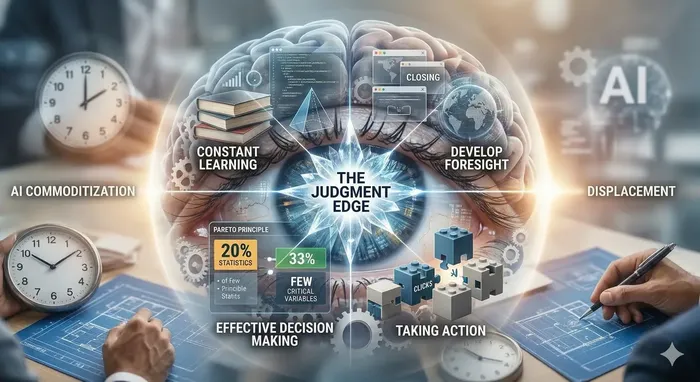
Constant Learning. Develop Foresight. Effective Decision Making. Taking Action.
All held together by what I call Optimistic Realism, the mindset that keeps these practices grounded and honest.
The critical insight I learned the hard way: having the practices isn’t enough. You need to feed them the right inputs.
Practice 1: Constant Learning: The 4-Hour Rule
Minimum 4 hours daily dedicated to learning. Non-negotiable.
Not courses only. Blended: reading, doing, watching, listening. Everyone learns differently. Find your mix.
But what you learn matters more than how much you learn. Those 4 hours should be split across three types of knowledge.
Foundational learning (1 hour): first principles, pure sciences, philosophy, core concepts. This is learning how to think, not what to memorise. If you’re in marketing, this is psychology and behavioural economics. If you’re in technology, this is relevant pure sciences and systems thinking. It gives you the why behind everything.
Applied learning (2 hours): your domain: techniques, tools, latest research in your field, what’s changing in your industry right now. This keeps you current and competitive.
Diversified learning (1 hour): cross-domain knowledge. Adjacent fields. Other industries. Market context. Geopolitics. Policy changes.
This last hour is where the real opportunities live.
Technology is converging. AI isn’t just for tech companies anymore. A healthcare professional with AI knowledge creates diagnostic opportunities. An agriculturist with logistics understanding sees supply chain innovation. An educator who understands psychology and technology builds personalised learning platforms. A finance professional who follows e-commerce trends spots payment infrastructure gaps.
The opportunities exist at the intersections. Three types of people are emerging in this landscape: the person who understands AI and their domain wins. The person who only knows AI becomes a commodity. The person who only knows their domain gets displaced.
The magic happens when you connect what you learn in hour 1 with what you learn in hour 4. When foundational thinking meets applied expertise meets cross-domain insight, you start seeing opportunities others miss.
Wrong inputs: studying only competitors, only your immediate domain, only what’s working right now.
Right inputs: foundational principles + applied expertise + diversified cross-domain knowledge.
Practice 2: Develop Foresight: Pattern Recognition, Not Prediction
Foresight isn’t about predicting the future. It’s about recognising patterns that repeat or manifest differently across contexts.
The process: absorb knowledge → apply it in practice → reflect → identify patterns.
Wrong inputs: trendy reports without context, prediction articles, pseudo-futurist manifestos. These are noise.
Right inputs: your actual knowledge, customer signals, market behaviour you’re observing firsthand.
The steps: study your domain deeply. Identify what’s working and failing and understand why. Map to similar patterns in other domains. Ask where this is heading in 18 months.
Why 18 months? Because foresight used to be a 5-year advantage. Now it’s 18 months.
E-commerce globalisation hit Pakistan 2 to 5 years after the West. That window is closing. AI adoption? Maybe 6 to 12 months lag now. You don’t have time to wait for proof. You need to position while others are still researching.
In 2016, we saw that global e-commerce platforms take 2 to 3 years to penetrate emerging markets. Pakistan’s e-commerce was exploding. We had a window. We became Pakistan’s only Shopify Plus Partner in 2018. By the time everyone understood Shopify’s dominance, we were already the go-to experts.
That’s not prediction. That’s pattern recognition.
Practice 3: Decision-Making: Identify the Critical Few
You will never have complete information for any meaningful decision.
Every decision has hidden variables you can’t see, future unknowns you can’t predict, and time constraints you can’t ignore. If you wait for certainty, you’ll never decide. The market will decide for you.
The skill isn’t gathering all the information. The skill is identifying which information matters most.
Pareto’s principle: 20% of variables drive 80% of outcomes. Your job is to find those critical few.
The framework:
- List all factors affecting the decision
- Ask: if you could only know 2 to 3 things with certainty, which would change your decision?
- Those are your critical variables
- Gather information on those
- Weight them
- Decide and accept that you won’t have everything
A market entry decision could involve 20+ variables. Or you identify the critical few: is there proven demand? Can we deliver profitably? Is there a defensible position? If those three check out, decide. The other 17 variables matter less.
Most decisions feel wrong in hindsight. That’s because future-you has more information. Don’t regret. Learn. Adjust. But don’t let “might feel wrong later” paralyse present-you.
Decision paralysis kills more businesses than bad decisions. You don’t have time to analyse 20 variables. The market window closes while you’re researching variable 15.
Identify the critical few. Decide on those. Move.
Practice 4: Taking Action: Build in Blocks, Not Roadmaps
Don’t build grand 18-month plans. Build testable blocks.
Small steps. Constant movement. Each block should be validatable before you build the next.
The process: identify the smallest testable unit. Build it. Test it. Learn from it. Decision point: kill, pivot, or scale? If scale, build the next block. Repeat.
Two advantages to this approach. First, speed to market: ship something small, fast. Second, optionality: you can rearrange blocks if direction changes. You’re not locked into sunk cost.
In 2010, MVP meant 6 months. In 2015, it meant 3 months. In 2025, it means 2 weeks. The advantage isn’t in building faster. It’s in testing assumptions faster.
Action isn’t just about shipping. It’s about learning whether you should keep building.
Build small. Test fast. Kill quickly. Scale what works.
When we built Ginkgo (our omnichannel engine), we didn’t build the full platform. Block 1: marketplace module. Tested with clients. Validated. Block 2: fulfilment logistics. Validated. Block 3: multi-channel support. Scaled. Each block took 3 to 6 weeks. Each had kill criteria. If clients hadn’t seen value in Block 1, we would have pivoted.
The Envelope: Optimistic Realism
These four practices need one more element to work: the right mindset.
To build anything, you need to be slightly more optimistic than realistic. Without conviction that this will work, you won’t put in the energy. Building anything meaningful requires believing in it before evidence exists.
But optimism without checks can destroy you. You’ll invest time and money into something that will never work. I learned this the hard way.
Two approaches keep it balanced.
The first: have someone around you who’s naturally sceptical: your business partner, a friend, a mentor. Their job is to challenge your assumptions and stress-test your hypothesis. They’re not there to discourage. They’re there to stress-test.
The second: treat every decision as an experiment. Build test cases and failure scenarios upfront. Define gates your actions must pass through. “If we don’t get 10 customers in 30 days, we kill this.”
Optimism gets you started. Realism keeps you alive. Stay slightly tilted towards optimism, but build the checks before you need them.
These Practices in Action (and One Major Failure)
The four practices work. But I’ve also seen clearly what happens when you have the practices but feed them the wrong inputs.
2014 to 2015: The Failure
June 2014. We started building an Education Management System (a SaaS for schools).
I did everything right: learning, forecasting, making decisions, taking action. December 2015, we shut it down after 18 months.
What went wrong? The inputs were wrong. I learned competitors, not customers. I predicted the trend, not actual school needs. I decided based on assumptions, not feedback. I built sequentially, not in testable blocks. And I was too optimistic with no reality checks built in.
Having practices isn’t enough. You need the right inputs. This failure changed everything that followed.
2016: The Experimentation Phase
We shut down the ERP direction and spent 9 months exploring. No single clear direction. This sounds like wasted time. It wasn’t.
We kept building capability. Deepened learning. Tested ideas quickly. Killed what didn’t work in weeks, not months. This was action in blocks: the right way.
Q4 2016, a retail brand approached us about e-commerce. We were ready because we’d practised killing ideas fast. When the right opportunity came, we could move immediately.
2016 to 2018: Corrected Inputs
We started an e-commerce department in 2016 with one client. Became a Shopify Partner in 2017. Achieved Shopify Plus Partner status in 2018: the only one in Pakistan at the time of writing this article.
The difference this time: we studied Shopify’s platform economics, not just how to build stores. We asked why platforms win. We combined foundational understanding (platform business models) with applied knowledge (Shopify ecosystem). We started with one client, not a grand vision.
2019 to 2020: All Practices in Sync
We built Ginkgo Omnichannel Engine in 2019. Six months before COVID hit.
We saw retailers struggling with inventory sync across online and offline channels. Pattern: omnichannel is inevitable. We didn’t predict COVID. We positioned for a problem COVID accelerated.
When COVID hit, retailers desperately needed omnichannel. We had it ready. Right product, right time. Not luck: positioning.
2021 to 2022: Knowing When to Kill Your Own Work
We started building Comverse, a marketplace solution, then merged it into Ginkgo.
Pareto applied: what are the critical variables for success? Answer: focus, not feature breadth. We identified overlapping value. Decision: consolidate. Optimism said keep building both. Realism said focus: one strong product beats two scattered ones. Realism won.
Most entrepreneurs keep building. Smart ones know when to consolidate.
2023 to 2024: Evolution Through Foresight
UnumPay, B2B Commerce, Flexum, Checkout Catalyst.
We studied infrastructure layer economics: Stripe’s model, AWS’s model, Shopify’s evolution. Pattern: the infrastructure layer always wins. The real opportunity: build for the builders, not the users.
Which infrastructure layers had the least competition in Pakistan? Payment infrastructure. B2B commerce. Mobile apps. All underserved. Each product launched as a testable experiment.
We went from building stores (2016 to 2018) to building tools for stores (2019 to 2021) to building infrastructure for builders (2023 to 2024). That’s not a pivot. That’s evolution through foresight.
The compounding pattern:
- 2016: Shopify partner → learned what merchants need
- 2017 to 2018: client integrations → saw repeating pain points
- 2019 to 2020: built SaaS products → understood infrastructure gaps
- 2021 to 2022: consolidation → positioned for scale
- 2023 to 2024: platform shift → serving the infrastructure layer
Each move taught us what the next move should be. In 2016, we served 1 client. In 2024, we serve the infrastructure layer for hundreds of businesses. That’s not 10x growth through execution alone. That’s positioning through compounding foresight.
Why This Matters More Now
These four practices aren’t new. I’ve been using them for 26 years.
What’s new is the speed multiplier.
In 2014, I had 18 months to realise I was wrong about the ERP. In 2026, you might have 6 months. Or 6 weeks.
The practices don’t change. The speed does. Which means good judgement compounds faster, bad judgement kills faster, positioning windows close faster, and recovery from mistakes is harder.
Speed without direction is chaos. These practices are your steering mechanism.
Five Questions Before You Move On
Write these down.
- On learning: when did you last spend 4 hours of consistent learning for a week in a row?
- On foresight: what pattern are you seeing that others are ignoring? Where will your industry be in 18 months? Are you positioning now?
- On decision-making: what decision are you delaying because you’re waiting for certainty you’ll never have? What are the 2 to 3 critical variables? Can you decide on those today?
- On action: what’s the smallest block you could build and test this week instead of planning next quarter? What experiment can you run today?
- On optimistic realism: who challenges your assumptions? Or are you only surrounded by people who agree with you? What test gates have you built, or are you trusting conviction alone?
In 2014, I wasted 18 months building the wrong thing. In 2026, you don’t have 18 months to waste.
These four practices won’t prevent failure. They’ll make failure cheap and success compounding.
Everyone has access to the same AI tools. The same automation. The same platforms.
Your edge isn’t the tools. Your edge is the judgement that guides how you use them.
This article is based on a keynote delivered at the International Conference on Advancements in Information Systems and Artificial Intelligence 2026, organised by the Department of Information Systems, Dr. Hasan Murad School of Management, University of Management and Technology, Lahore, on January 27, 2026.